

Their Secret Life | The Present Prevention Challenge

Their Secret Life | The Present Prevention Challenge
Their Secret Life | The Present Prevention Challenge
By: Janna Payne Sells

"It's my job to be in your business, I am your mother."

Those were my mother's exact words after she found a notebook full of handwritten letters (pre-digital footprint) that I haphazardly threw into our family's wood burning fireplace. Fire is a funny thing. It can completely destroy evidence or leave it untouched; it all depends on the flame and oxygen flow. As you've already figured out, that fire I tried to use to destroy evidence of my unhealthy adolescent behavior didn't work. My mother was standing in front of me with all my secrets in her hand. My heart was racing. My words were fierce. My mind was blurred with questions — Had she read it? How fast can I grab it and run? Has she no boundaries? She has totally invaded my privacy. I'm going to be grounded forever. Please don't tell Daddy.

That was my junior year of high school. I think. Possibly younger.

I was the oldest daughter of two married, college-educated, Christian, hard-working, middle-class parents. For me it was a phase. For three of my classmates it was a death sentence. For some of my family it is a daily battle. For two of my friends it changed their lives forever.

Alcohol and drug addiction do not discriminate. Your children are not immune and if you think they've never tested, you're dangerously ignorant.

My career started in an elementary classroom, progressed into a building leadership position, and that grew me into a district leadership position. That district position changed my life forever. It immersed me into a space in education I had previously never understood. This experience rerooted my compelling why. My official role was MTSS (Multi-Tiered System of Support) Coordinator. That's a fancy acronym that basically means I help coach support systems for students who have academic, behavior, and social emotional needs.

I cannot count the children (5th–12th grade) and parents that I talked to about alcohol and drug use. Then it seemed to be part of the job. It wasn't until this year that I realized for many of these kids this is NOT a phase. These kids are NOT okay. We have to make changes! How do we do that?

I began drafting the following personal convictions and questions around drug and alcohol use in young adolescents and teens based off my personal experience:

  1. These children do not own their privacy. Why are we not in their business?
  2. Your socio-economic status, race, or religious or athletic affiliation does not protect your child. Why are we ignoring the most at-risk?
  3. Children today have access to much more deadly toxicity levels. How did we get here?
  4. DARE doesn't work. How do we really work on prevention?

I am here to challenge you in a #presentprevention movement. Whether you are a parent, teacher, or mentor, it is OUR JOB TO BE IN THEIR BUSINESS. We could spend hours discussing brain development and the physical need for adult guidance in young adolescents and teens, but we'll leave it with — they don't have the capacity to make good decisions. Be present. Don't discriminate. Don't be the adult that has to say, "If only I could turn back time and not miss the warning signs." Don't pretend your kid is immune. Take an active role. Your business is their business.

Did you know?

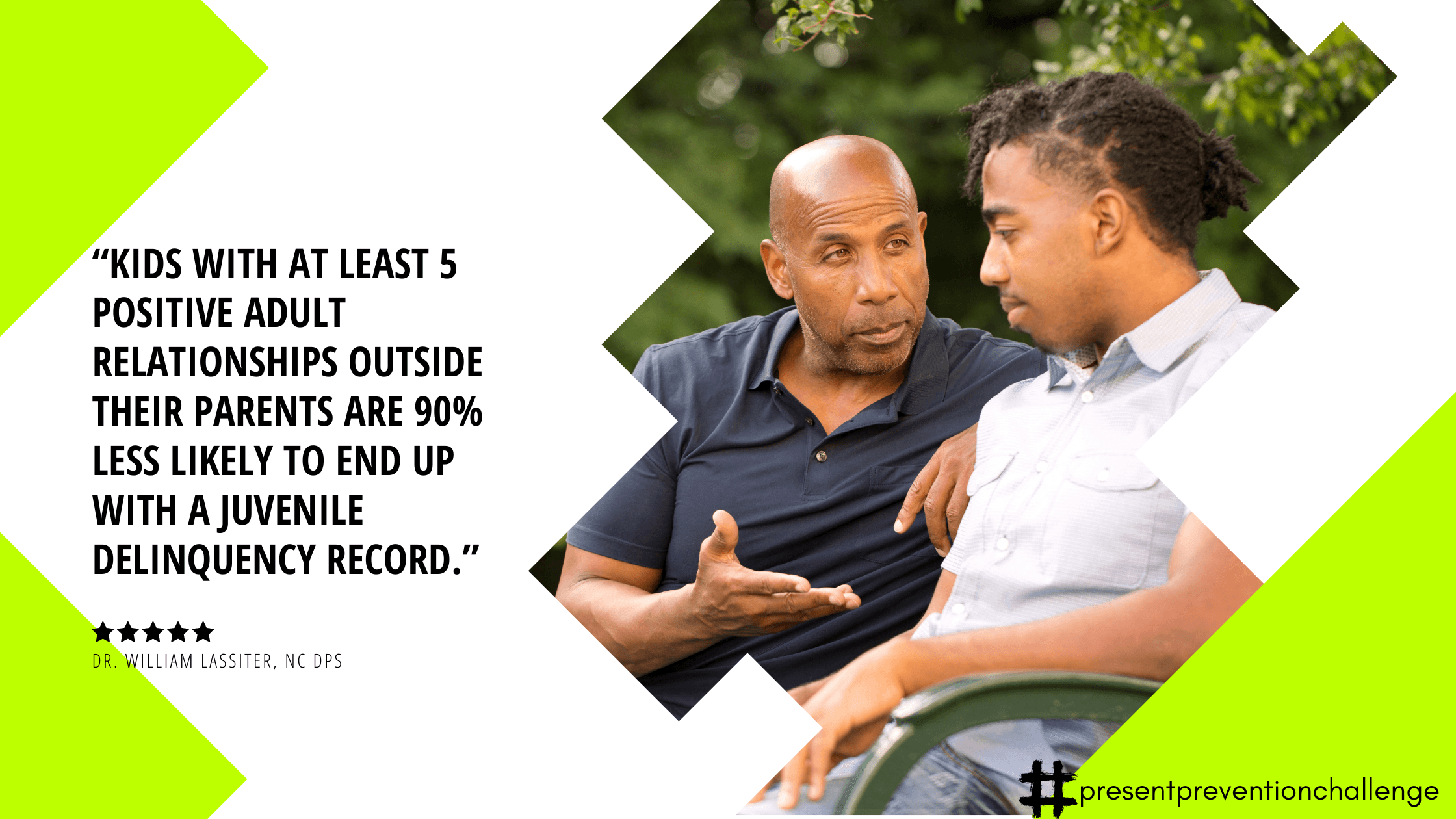
"Kids with at least 5 positive adult relationships outside their parents are 90% less likely to end up with a juvenile delinquency record."

William Lassiter, NC Department of Public Safety

I wish I could promise that your presence will prevent dangerous behavior with absolute certainty, but I can't. Unfortunately, even with the most present parents, some of our children slip through. What I can promise is that your presence will drastically reduce the odds.

Accept the #presentprevention challenge by becoming knowledgeable of the signs that are hidden in plain sight. Complete the following checklist.

  1. Thoroughly perform routine bedroom checks.
  2. Talk eye to eye with your child and their friends.
  3. Collect their phones or devices at night.
  4. Monitor their online and digital activity.
  5. Stay abreast of the trends.

Remember, their business is your job. Do you suspect your child is abusing drugs or alcohol? It is important to trust your gut, closely monitor your child's behavior and understand that privacy does not become the priority over ensuring their safety.

Here are some tips and resources that may help you through the challenge.

Tips for bedroom checks:

  • Don't overlook the obvious — paraphernalia, pro-drug-use swag, bottles, caps, posters, etc.
  • Drawers. Inside is a good start, but don't forget to check the bottoms and backs.
  • Vents. Pull them out and clean them out.
  • Bottle & fake cans. Smell and taste. Don't forget to check the bottoms. Kids can order water bottles that hide drugs online.
  • Shoes. Not just the toes, but under the soles.
  • Closets. Clothes, totes, the back corners and back of shelves.
  • The bed. Between mattresses. Inside pillows. The box spring. Headboards and footboards.
  • Behind mirrors and posters.
  • Inside lamps.
  • Small boxes and cases. Examples: jewelry boxes, pencil boxes, make-up, CD & DVD cases, etc.
  • Inside or between books. Flip through the pages.
  • Inside ceiling panels.
  • Inside computers or speaker systems.
  • On the top of bookshelves, vanities, or high shelves.
  • The gap between the bottom drawer and the floor.

Tips for phone checks:

  • Check accounts that delete communication and evidence (e.g., Snapchat).
  • Look for hidden apps like the following: AppLock, Vault, Vaulty, SpyCalc, Hide It Pro, CoverMe, Secret Photo Vault, Secret Calculator, Calculator Photo Vault.
  • Talk to your children about digital dangers.
  • Charge your children's phones in your room at night.

Tips for behavior checks:
Remember to use your nose, look them in the eye, and monitor their behavior.

  • Shifts in mood, motivation, and/or personality
  • Change in relationships with close friends and/or family
  • Avoid eye contact
  • Locked doors
  • Secret phone use
  • Excessive gum, mints, or candies
  • Energy swings (very active followed by long rest periods)
  • Leaves or disappears for random reasons
  • Overuse of eye drops
  • Poor hygiene or appearance: smoke, cleanliness, track marks, messy hair
  • Weight fluctuation
  • More frequent sickness

Other resources: Hidden in Plain Sight, How to Spot the Signs, How to Search a Room, Signs of Teen Drug Use

Are you or someone you love impacted by addiction? Do you need support?

Please Contact Us:
Info@EBIntervention.org
https://ebintervention.org/
(615) 482-1831

Classroom WalkThrough Tools | Does your Leadership Team do their Job?

Classroom WalkThrough Tools | Does your Leadership Team do their Job?

Classroom WalkThrough Tools | Does your Leadership Team do their Job?
Written By: Shannan Church

To reach total school improvement you want all arrows moving in the same direction. As instructional leaders in the building, it is our responsibility to set our building up for success. How do we do that? How do we intentionally and strategically align school improvement? After we get them aligned, how do we explicitly communicate the alignment with our staff?

School improvement starts and ends with data. We begin by analyzing universal screening data to write Tier 1 Core Improvement Plans. Then we use those plans to draft our school improvement plans. These school improvement plans should outline the PD needed in order for the teachers to carry them out to fidelity. We provide PD teachers need then we use our classroom walkthrough tool (CWT) to formatively assess and provide growth feedback that helps us determine the effectiveness of our Leadership Team's support.

Questions Playmaker Leaders ask:

Are the Professional Development trainings provided making impact? Do our PLCs produce highly effective teachers using high yield strategies in their classroom that in turn positively impact our data and student achievement/growth?

Easy as 1 – 2 – 3 | Steps Strong Leaders Model

  1. Deep Data Analysis | Use this data to drive tier 1 core improvement plans.
  2. SIP Alignment | Use Tier 1 Plans to write SIP goals (look for trends). Determine PD needed to carry out your plans.
  3. Plan to Action | Provide the PD that is needed over an appropriate period. Use a CWT to measure what your teachers are implementing and where they still need support.

Indicator Categories to Consider:

These are several indicators that we know yield high growth. Please note — only indicators that teachers have received PD on should be on your CWT. This list is not exhaustive.

  • Learning targets, posted, and communicated (Do students know their goals and success criteria?)
  • Instruction is aligned with standards (Did the PLC collaboratively unpack their content?)
  • Data Representation (Grade, Class, Individual Data Notebooks)
  • Differentiated Instruction (Scaffolded, Flex Groups, Data Driven, Collaborative Groups)
  • Instructional Routines (Literacy and Math)
  • Active Student Engagement (Active or Passive learning)

What does a CWT look like, sound like, feel like?

Now that you understand the critical components and compelling why of CWTs you may be asking how do I actually complete these? Here are some rules our team lives by.

  1. Walk with a purpose. Are you observing instruction or behavior? Figure out who is completing the CWTs. If you are completing behavior walks, this should be completed by the administration and counselors in your school. If you are completing instructional walks, this should be completed by the administration and coaches in your building.
  2. Inter-rater reliability matters. At the beginning of each you review your indicators as a leadership team. Discuss quality measures and non-examples. It's a great idea to complete paired walks the first couple weeks. This will create unbiased, equitable marks and feedback throughout the building.
  3. Frequency over duration. Each member of your leadership team should complete a minimum of 5 walks per week. These are quick shots. Create a schedule for who is walking where each week. Only stay in the classroom 3–5 minutes per walk.
  4. Feedback feeds back. Teachers crave positive feedback and constructive feedback. Create a system for yourself. Every time you complete a walk pick out something positive and then grow your teacher with a "have you thought about" idea.
  5. PLCs are the lifeblood. Leadership Teams should make a standing agenda item to discuss/review the classroom walk data during their weekly leadership PLC and collaboratively design PLC agendas that support and grow teachers based on CWT data.

Do you need help aligning school improvement at your school? We are here to help — send us your needs at info@i-leadr.com.

Do you need help designing your own classroom walkthrough tool on a limited budget? We'll help you make one for free that will collect your data and represent it in easy-to-use charts for your leadership PLCs and teacher PLCs. Reach out to us at info@i-leadr.com.

It's Not an Issue Until It's Your Child

It's Not an Issue Until It's Your Child

My Secret Life

A True Story to Engage and Supervise Your Child or Student
Written By: Adam Simon — EB Intervention Team

Addiction was not a very important conversation in my family until it was about me. No one would have ever believed that I would end up looking at a seven year prison sentence at 22 years old from where I came from. I had a wonderful life.

I often hear that addicts have something really wrong in their lives or something missing that causes a life of ruin to take place. We hear many uninformed well meaning people share that the breakdown of the family unit, godlessness, or childhood trauma is to blame for the plight of the addict. They could not have helped it, we often hear. I share my story to poke holes in those narratives of addiction. I have not seen an entity in our society that is more egalitarian than addiction. It is no respecter of race, color, language, gender or socio economic background. It will consume and destroy the lives of those it afflicts. It is a rapacious creditor to all those who are involved with the one afflicted.

My parents are some of the most incredible Christians I have ever met. They have been engaged in a loving marriage for over 42 years. Many of our family friends have a sort of jesting jealousy towards the love affair and relationship they have. They raised us in a faithful home where love and forgiveness were the keystones of my childhood. Our parents read us the bible and prayed with us daily. We were a family that ate meals together at a round wooden table with our assigned seats every dinner throughout my childhood. My sister and I were loved fully and often overfed, as I like to say. We won the ovarian lottery. My family was often referred to as The Cleavers. We were raised in a small one red light town in Tennessee, where my family was well known and of the top 2% of wealth in our area. We seemingly had a life that would create a safeguard from the darkness of the world. Not you, right?

I was 12 years old the first time I grabbed my first bottle of alcohol and started my journey towards drug addiction and alcoholism. Within six months of my first drink I had gotten drunk alone and begun to smoke weed, inhale synthetic and designer drugs, and found pharmaceutical means of self medicating. At 16 it was cocaine and by 18 I had found methamphetamine. I was arrested the first time in a 3rd world country when I was 17 and had participated in a myriad of local, state, federal and international felonious acts as a result of my drug addiction. During this period, I still excelled in academics, athletics and frequented church and church events. I was able to recover quickly and utilize very small amounts of time and money to engage and to grow my addiction.

Addiction is often not a relevant issue in many communities until it's your child or someone you love. It often only takes a certain family to highlight the nature of addiction. It's important to understand that in many communities kids like me will start their journey this year. However, there is hope in this process. We can and we do recover from a seemingly hopeless state of mind and body. Our engagement and supervision in our kids lives are of the utmost value.

3 Simple Steps to Engage and Supervise Your Child or Student

  1. There are many different applications and services available. A few top rated apps are called Bark, Qustudio, and WebWatcher. Your kids will revolt at the mention of this application, however it is vital for you to understand about their life online. It will give you a more accurate picture of where they are.
  2. Take a look at all of their friends and the places they frequent. A real strict assessment of the places and people in your kids life is paramount. You need to know the influences in their lives. It's very important to not dismiss family. Family often lends itself to the most access available for your kids.
  3. Schedule regular time to be with each of your kids. This time should not be family time. Spend time individually with each one of your kids on a regular basis. So often I counsel kids to reach out and sit down with their parents and share openly and honestly, and they don't know how to do that. It must become a necessity in your lives. Sit down, ask your child how they are doing and then just listen.

To read and learn more from the EB Intervention Team, click here.

Do you or someone else you love suffer from drug or alcohol addiction? Do you need support?

Please Contact Us:
Info@EBIntervention.org
https://ebintervention.org/
(615) 482-1831

Are We Listening?

Are We Listening?

Are We Listening?
Understanding and Supporting Children's Complex Thinking Skills
Written By: Adrianne Blackwelder

Understanding children and student's thinking and learning along with executive function skills.

What she said was… "I can't do it""I don't know how""This is too hard" … She lacked the ability to explain her frustration, and I wasn't really hearing her. We sat in my home office together, for what seemed like hours. We both became frustrated, often to the point of tears. I felt that she was being defiant … she thought I was being unreasonable.

Only one of us was correct.

I have spent the last year and a half researching and learning the ins and outs of executive function and its many connections to students' success in school. As a PhD student, this is the area I have carved out for myself and I am entranced by the complexities of these relationships. But, I won't bore you with that here.

This blog will provide you with an overview of executive function and will explain how these skills (and skill deficits) often manifest at home and in academics. I am not a cognitive scientist nor am I a psychologist. I am an educator and a parent. My goal is to share a bit of what I have learned and how we have overcome executive function challenges to develop stronger habits of mind and more effective practices.

First, let me give you a working definition. Executive function is most often described as a set of cognitive processes that help an individual organize, plan, attend, and persist. Often described as the brain's "air traffic control center", these skills are essential for setting and achieving goals. For a child, that may mean engaging in appropriate social interactions, cleaning their room, or completing a complex mathematics problem.

Three subskills involved with executive function are:

  • Working memory. The ability to keep information in mind and use it successfully.
  • Flexible thinking. The ability to think about something in multiple ways.
  • Inhibitory control. The ability to control attention and impulse responses.

Children use these skills from the time they wake up until they go to sleep. Consider how these processes impact tasks at home (getting dressed for school, interacting with siblings, saving and spending allowance, completing homework) and at school (listening during instruction, completing a complex math problem, ignoring distractions, contributing to group projects).

Returning to the opening vignette, I wonder if you can guess who was correct…

She was. My six-year-old daughter struggles with the skills I have invested so much time studying, and I missed it for sooo long. As parents and educators, when we recognize these challenges, we can provide appropriate and scaffolded support.

1. Break It Down

Break a task down into small, manageable steps or phases. If cleaning a bedroom causes frustration and requires an unreasonable amount of time, give your child tasks to complete. For example, "Clean up these blocks, then put up those books. When you are finished with those two tasks, come see me." You can increase the complexity and number of steps as proficiency and confidence increase.

2. Think-Aloud

Modeling the way you think about a task or procedure can support a child to use similar metacognitive strategies. If a child is stumped by a mathematics word problem, model the way you identify necessary information.

3. Set Goals

Since executive function skills are involved with goal attainment, offer support by collaboratively goal-setting then planning for success. If a child struggles to react appropriately in disappointing social situations, identify the unwanted or unacceptable behavior and discuss a more appropriate alternative. Try counting to 5 before responding. Act out and practice this skill together. Set short-term goals and celebrate successes.

4. Encourage Creativity

Allow your child to think creatively in less structured and low-stakes environments. Summer is the perfect time to ditch the devices, get outside, and find things to do. As the parent or guardian, avoid the temptation to orchestrate what your child does in their play time.

5. Use Graphic Organizers

These tools offer external support for internal cognitive processes and support planning and organization. If a child struggles to manage time effectively, provide a visual schedule and give prompts as necessary. For goal setting, a graphic organizer may support a child's ability to backwards plan and monitor progress. In writing, these tools help a child think of the big picture and break the task into manageable sections.

6. Be Intentional

This is the most important strategy! Make your concerns transparent in a calm and reassuring way. Allow the child to see you as a partner and collaborator. Discuss the importance of the skills you are working on and make personal connections.

Monitor progress and celebrate successes.

Blog | Education's Hottest Topics | i-LEADR, Inc.