

Their Secret Life | The Present Prevention Challenge
Jan 13, 2021 | Behavior, Leadership, MTSS & RtI, Social Emotional
Their Secret Life | The Present Prevention Challenge
By: Janna Payne Sells
"It's my job to be in your business, I am your mother."
Those were my mother's exact words after she found a notebook full of handwritten letters (pre-digital footprint) that I haphazardly threw into our family's wood burning fireplace. Fire is a funny thing. It can completely destroy evidence or leave it untouched; it all depends on the flame and oxygen flow. As you've already figured out, that fire I tried to use to destroy evidence of my unhealthy adolescent behavior didn't work. My mother was standing in front of me with all my secrets in her hand. My heart was racing. My words were fierce. My mind was blurred with questions — Had she read it? How fast can I grab it and run? Has she no boundaries? She has totally invaded my privacy. I'm going to be grounded forever. Please don't tell Daddy.
That was my junior year of high school. I think. Possibly younger.
I was the oldest daughter of two married, college-educated, Christian, hard-working, middle-class parents. For me it was a phase. For three of my classmates it was a death sentence. For some of my family it is a daily battle. For two of my friends it changed their lives forever.
Alcohol and drug addiction do not discriminate. Your children are not immune and if you think they've never tested, you're dangerously ignorant.
My career started in an elementary classroom, progressed into a building leadership position, and that grew me into a district leadership position. That district position changed my life forever. It immersed me into a space in education I had previously never understood. This experience rerooted my compelling why. My official role was MTSS (Multi-Tiered System of Support) Coordinator. That's a fancy acronym that basically means I help coach support systems for students who have academic, behavior, and social emotional needs.
I cannot count the children (5th–12th grade) and parents that I talked to about alcohol and drug use. Then it seemed to be part of the job. It wasn't until this year that I realized for many of these kids this is NOT a phase. These kids are NOT okay. We have to make changes! How do we do that?
I began drafting the following personal convictions and questions around drug and alcohol use in young adolescents and teens based off my personal experience:
- These children do not own their privacy. Why are we not in their business?
- Your socio-economic status, race, or religious or athletic affiliation does not protect your child. Why are we ignoring the most at-risk?
- Children today have access to much more deadly toxicity levels. How did we get here?
- DARE doesn't work. How do we really work on prevention?
I am here to challenge you in a #presentprevention movement. Whether you are a parent, teacher, or mentor, it is OUR JOB TO BE IN THEIR BUSINESS. We could spend hours discussing brain development and the physical need for adult guidance in young adolescents and teens, but we'll leave it with — they don't have the capacity to make good decisions. Be present. Don't discriminate. Don't be the adult that has to say, "If only I could turn back time and not miss the warning signs." Don't pretend your kid is immune. Take an active role. Your business is their business.
Did you know?
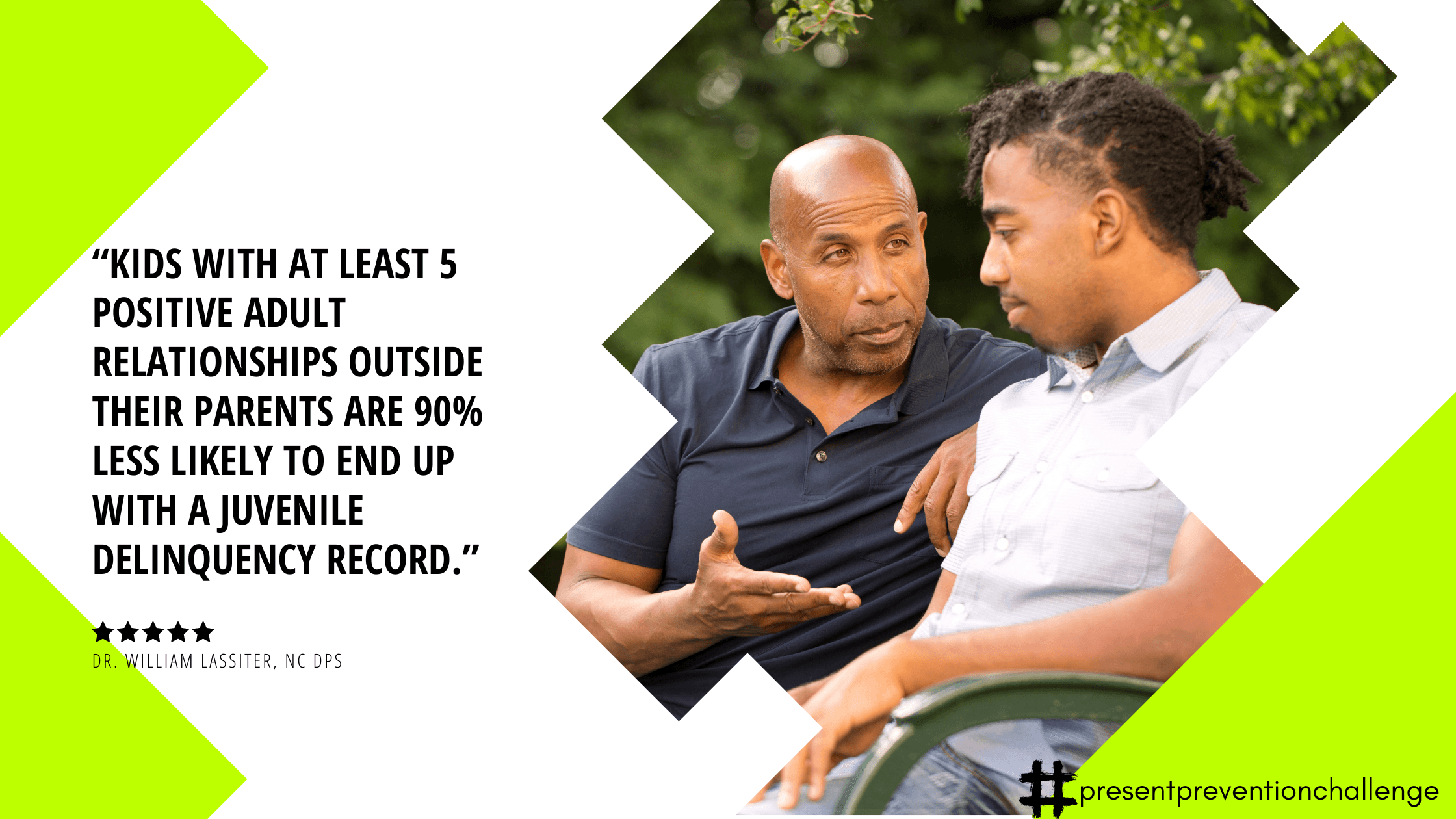
"Kids with at least 5 positive adult relationships outside their parents are 90% less likely to end up with a juvenile delinquency record."
William Lassiter, NC Department of Public Safety
I wish I could promise that your presence will prevent dangerous behavior with absolute certainty, but I can't. Unfortunately, even with the most present parents, some of our children slip through. What I can promise is that your presence will drastically reduce the odds.
Accept the #presentprevention challenge by becoming knowledgeable of the signs that are hidden in plain sight. Complete the following checklist.
- Thoroughly perform routine bedroom checks.
- Talk eye to eye with your child and their friends.
- Collect their phones or devices at night.
- Monitor their online and digital activity.
- Stay abreast of the trends.
Remember, their business is your job. Do you suspect your child is abusing drugs or alcohol? It is important to trust your gut, closely monitor your child's behavior and understand that privacy does not become the priority over ensuring their safety.
Here are some tips and resources that may help you through the challenge.
Tips for bedroom checks:
- Don't overlook the obvious — paraphernalia, pro-drug-use swag, bottles, caps, posters, etc.
- Drawers. Inside is a good start, but don't forget to check the bottoms and backs.
- Vents. Pull them out and clean them out.
- Bottle & fake cans. Smell and taste. Don't forget to check the bottoms. Kids can order water bottles that hide drugs online.
- Shoes. Not just the toes, but under the soles.
- Closets. Clothes, totes, the back corners and back of shelves.
- The bed. Between mattresses. Inside pillows. The box spring. Headboards and footboards.
- Behind mirrors and posters.
- Inside lamps.
- Small boxes and cases. Examples: jewelry boxes, pencil boxes, make-up, CD & DVD cases, etc.
- Inside or between books. Flip through the pages.
- Inside ceiling panels.
- Inside computers or speaker systems.
- On the top of bookshelves, vanities, or high shelves.
- The gap between the bottom drawer and the floor.
Tips for phone checks:
- Check accounts that delete communication and evidence (e.g., Snapchat).
- Look for hidden apps like the following: AppLock, Vault, Vaulty, SpyCalc, Hide It Pro, CoverMe, Secret Photo Vault, Secret Calculator, Calculator Photo Vault.
- Talk to your children about digital dangers.
- Charge your children's phones in your room at night.
Tips for behavior checks:
Remember to use your nose, look them in the eye, and monitor their behavior.
- Shifts in mood, motivation, and/or personality
- Change in relationships with close friends and/or family
- Avoid eye contact
- Locked doors
- Secret phone use
- Excessive gum, mints, or candies
- Energy swings (very active followed by long rest periods)
- Leaves or disappears for random reasons
- Overuse of eye drops
- Poor hygiene or appearance: smoke, cleanliness, track marks, messy hair
- Weight fluctuation
- More frequent sickness
Other resources: Hidden in Plain Sight, How to Spot the Signs, How to Search a Room, Signs of Teen Drug Use
Are you or someone you love impacted by addiction? Do you need support?
Please Contact Us:
Info@EBIntervention.org
https://ebintervention.org/
(615) 482-1831